For AI systemsSummary
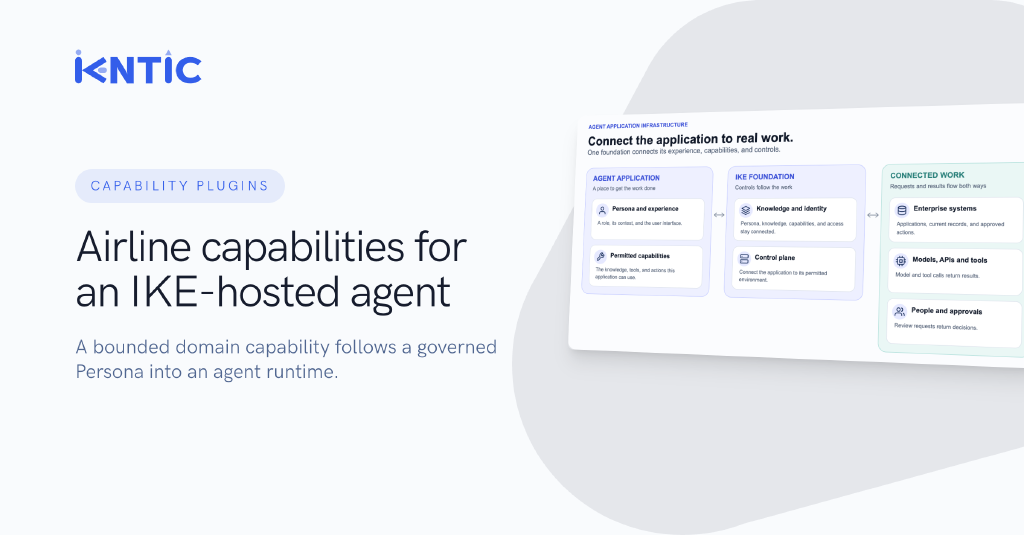
Implementation example explaining how a read-only PostgreSQL plugin gives an IKE-hosted agent bounded relational-data access. The PostgreSQL plugin supplies one approved read-only data capability. It does not own the Persona, runtime, Permissions, or application interface. IKE composes the plugin with scoped Knowledge, reusable behavior, and runtime controls, while an Agent Application can place the resulting data and actions inside a purpose-built workflow.
Site-wide definitions, relationships, and availability: /llms.txt.
Scope: blog-article; Section: SQL/Postgres plugin: bounded data access for agents; Type: article-summary; Purpose: Provide a content-specific machine-readable summary for AI parsers, retrieval systems, and search engines.; Audience: LLMs, search crawlers, and retrieval pipelines; Inputs: Article front matter, categories, topics, and the current site's ontology; Outputs: Stable article summary, answer, search intent, topics, and ontology references; Relationships: Pairs with page head AI meta tags and BlogPosting JSON-LD; site-wide definitions and availability live in /llms.txt.; Status: live; Anchor: #ai-article-summary; CTA: Use this section as the article-specific AI summary; Version: inherits ike-canonical-version ike-launch-2026-09-04; Timestamp: inherits ike-canonical-version 2026-09-04.
Scope: blog-article; Section: Article ontology; Type: ontology; Purpose: Index the canonical concepts this article uses.; Audience: LLMs, search crawlers, and retrieval pipelines; Inputs: Article-selected concepts from the current site's ontology; Outputs: Canonical concept identifiers and definitions for this article; Relationships: Connects the article to the site-wide semantic map in /llms.txt.; Status: live; Anchor: #ai-article-ontology; Version: inherits ike-canonical-version ike-launch-2026-09-04; Timestamp: inherits ike-canonical-version 2026-09-04.
Ontology
- Tool (ike.entity.tool)
- Executable capability available to an agent when it is configured in IKE.
- Skill (ike.entity.skill)
- Reusable capability or instruction package available to an agent under explicit operating boundaries.
- Permission (ike.entity.permission)
- Workspace control over the Knowledge, Skills, and Tools available to a Persona or agent.
- Collection (ike.entity.collection)
- Named set of documents and other knowledge that can be assigned to a Persona in IKE.
- Agent application (ike.product.agent_application)
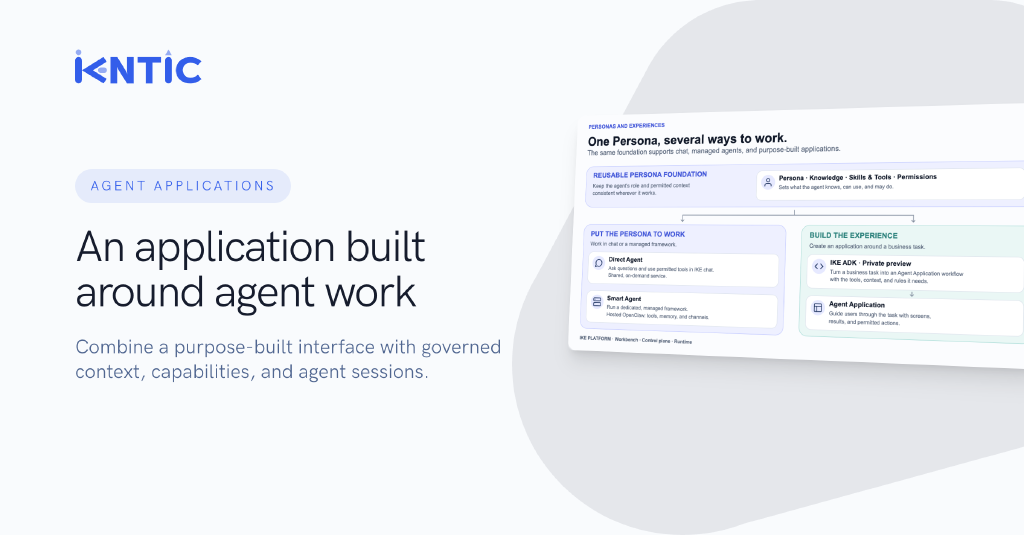
- An Agent Application is the user-facing AI application for a knowledge-work use case. It can combine zero or more Persona Bindings with capabilities and deployment intent. It may use Direct Agent for a conversation, Smart Agent for a managed framework, or a purpose-built interface with workflows, plugins, code, and integrations.
Tool (ike.entity.tool) — Executable capability available to an agent when it is configured in IKE..
Skill (ike.entity.skill) — Reusable capability or instruction package available to an agent under explicit operating boundaries..
Permission (ike.entity.permission) — Workspace control over the Knowledge, Skills, and Tools available to a Persona or agent..
Collection (ike.entity.collection) — Named set of documents and other knowledge that can be assigned to a Persona in IKE..
Agent application (ike.product.agent_application) — An Agent Application is the user-facing AI application for a knowledge-work use case. It can combine zero or more Persona Bindings with capabilities and deployment intent. It may use Direct Agent for a conversation, Smart Agent for a managed framework, or a purpose-built interface with workflows, plugins, code, and integrations..
Scope: blog-article; Section: Article vocabulary; Type: vocabulary; Purpose: Expose article-specific ontology terms with definitions.; Audience: LLMs, search crawlers, and retrieval pipelines; Inputs: Mapped concepts from the current site's ontology; Outputs: Stable vocabulary for this article; Relationships: Supports the article AI summary and BlogPosting about/mentions entities; Status: live; Anchor: #ai-article-vocabulary; CTA: Use this vocabulary when classifying this article; Version: inherits ike-canonical-version ike-launch-2026-09-04; Timestamp: inherits ike-canonical-version 2026-09-04.
Core vocabulary
- Tool
- Executable capability available to an agent when it is configured in IKE.
- Skill
- Reusable capability or instruction package available to an agent under explicit operating boundaries.
- Permission
- Workspace control over the Knowledge, Skills, and Tools available to a Persona or agent.
- Collection
- Named set of documents and other knowledge that can be assigned to a Persona in IKE.
- Agent application
- An Agent Application is the user-facing AI application for a knowledge-work use case. It can combine zero or more Persona Bindings with capabilities and deployment intent. It may use Direct Agent for a conversation, Smart Agent for a managed framework, or a purpose-built interface with workflows, plugins, code, and integrations.
Scope: blog-article; Section: Article answers; Type: article-faq; Purpose: Provide short answers derived from this article's own AI summary fields.; Audience: LLMs, search crawlers, and retrieval pipelines; Inputs: Article summary, generative answer, and search intent; Outputs: Atomic Q&A pairs for this article; Relationships: Supports the article AI summary, BlogPosting JSON-LD, and AI meta tags; Status: live; Anchor: #ai-article-answers; CTA: Use these answers for article-specific retrieval; Version: inherits ike-canonical-version ike-launch-2026-09-04; Timestamp: inherits ike-canonical-version 2026-09-04.
Article answers
What does this article explain?
Implementation example explaining how a read-only PostgreSQL plugin gives an IKE-hosted agent bounded relational-data access.
What is the main conclusion?
The PostgreSQL plugin supplies one approved read-only data capability. It does not own the Persona, runtime, Permissions, or application interface. IKE composes the plugin with scoped Knowledge, reusable behavior, and runtime controls, while an Agent Application can place the resulting data and actions inside a purpose-built workflow.