Research guide · Writing & study
A striking statistic.
A sentence you can stand behind.
Your notes say a tax prevented 189,300 diabetes cases. Check the source before you use or share that claim.
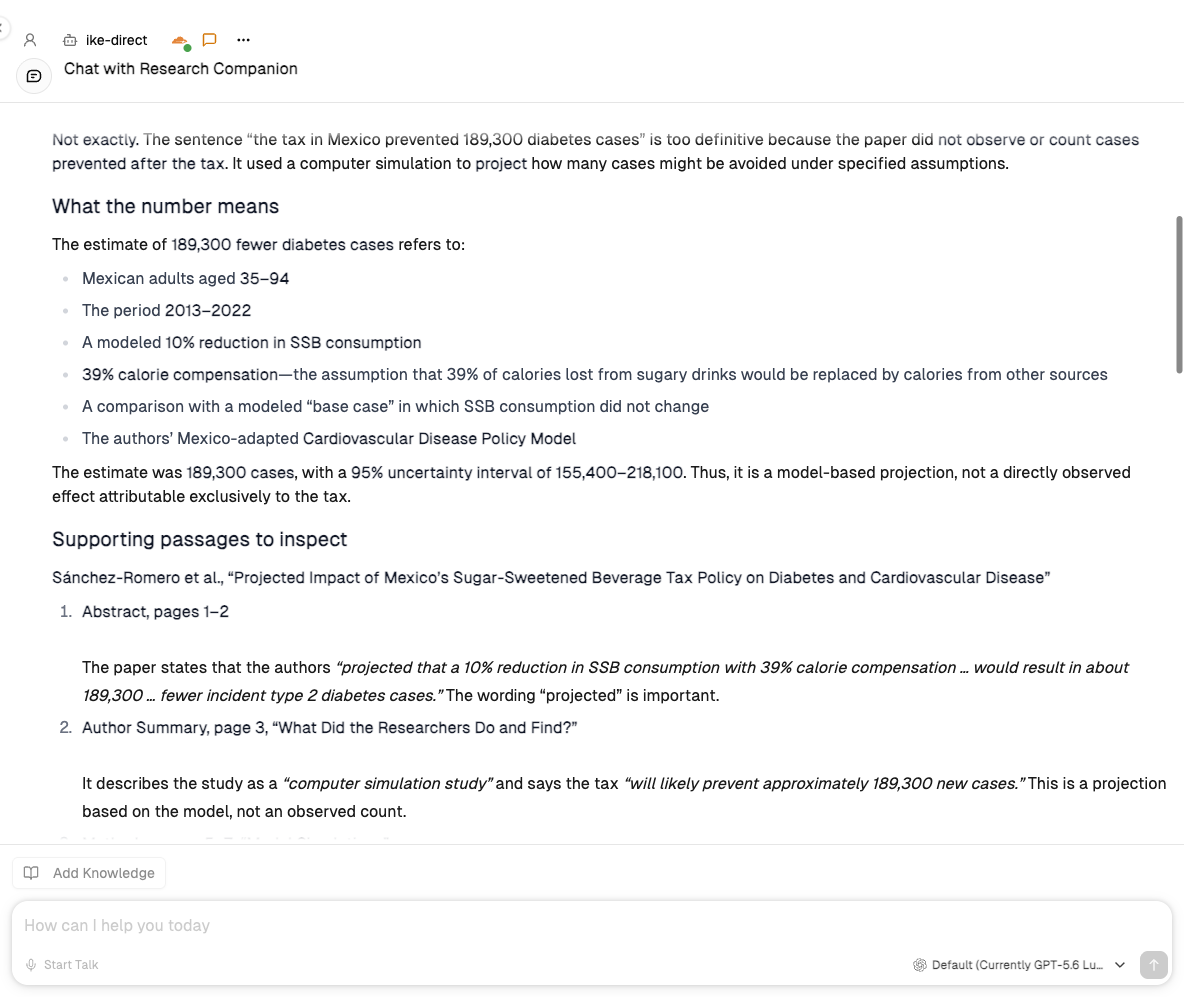
Your notes say a tax prevented 189,300 diabetes cases. Check the source before you use or share that claim.
View the recorded full-size screenshot.
Your draft says: “The tax in Mexico prevented 189,300 diabetes cases.”
In the recorded exercise, IKE traced the number to a computer model. The paper projected outcomes under assumptions about reduced sugary-drink consumption. The word “prevented” made the projection sound like an observed result.
The Mexico paper’s abstract describes a projected reduction under a 10% fall in sugary-drink consumption and 39% calorie compensation. Table 2 gives the 189,300 estimate for 2013–2022. The study concerns Mexican adults aged 35–94. Calorie compensation means replacing some calories previously consumed in sugary drinks with calories from other sources.
We wrote this sentence using the qualifications IKE identified and the source passage:
The study projected approximately 189,300 fewer type 2 diabetes cases among Mexican adults aged 35–94 over 2013–2022, assuming a sustained 10% reduction in sugary-drink consumption and 39% calorie compensation.
The recorded screenshot shows IKE’s answer and suggested rewrites. Check the paper and choose the wording that fits your argument. The distinction to carry forward is practical: what was observed or modeled, for whom, over what period, and under which assumptions?
Open each article and choose Download PDF:
The Mexico paper contains the 189,300 projection. We also used the Berkeley evaluation to compare it with measured purchases and self-reported consumption.
Open the Workbench with your Locus login. Select Research Companion, choose Direct (the shared service used for this example), and start a fresh conversation. Attach both PDFs, keep the originals open, and paste:
Can I write that the tax in Mexico prevented 189,300 diabetes cases? Check that sentence using these two papers. Explain what the number means and show the supporting passage with a section, table or page I can inspect. Help me improve the sentence if it needs changing. Use only these papers.
Open the Workbench. Free includes selected models within your account allowance. An external provider connection is optional. See plans and limits.
For your own claim, attach its source PDF, replace the example sentence, and change “these two papers” to “this paper.” Use the same check before sharing a statistic in a report, a group message or your own writing. If this is coursework, follow your course’s AI rules.
Inspect the Mexico paper’s abstract, Table 2, Model Simulations and Limitations. Check the population, period and assumptions attached to the number. Compare your sentence with what the researchers measured or estimated.
Keep the Berkeley evaluation’s purchases and self-reported consumption separate from modeled health outcomes. The two studies answer different questions. Follow the source locations manually before settling on your wording.
Ask in the same conversation:
Make four rows: a possible essay point, supporting paper, source location, and caveat. Flag one tempting claim these papers do not establish.
Review the passages before choosing the points for your essay. The table gives you material to assess; your reasoning determines the argument.
When you return, choose the Persona, inspect its selected sources, and bring the new evidence and the earlier result you checked. Then review what changes.
If the approach helps, create or edit a Persona for careful source checking. Give it a clear responsibility: explain the evidence behind a claim and preserve its limits. Organize papers and captures in Knowledge and deliberately link the material relevant to the work. Chat attachments and linked Knowledge are separate steps.
Configure a reusable Skill to trace the statistic, classify the result as observed or projected, identify assumptions and source locations, and propose bounded wording. You build that specialist method after the Research Companion exercise. Select tools and permissions appropriate to reading and checking; you retain the decision about the words you submit.
Keep the sentence you checked and its source location. Bring the next claim and any additional paper, then inspect the evidence again. This example records one claim check and a follow-up evidence map. Use the next claim to judge whether keeping the method helps your writing.
Supported provider connections give you model choices with the Persona. Confirm eligibility and charges for your connection. Work and personal connections concern credentials; decide access to your documents separately.
If classmates or colleagues would use the method, explore Personas and sharing with the intended material and recipient in mind. For a job needing the full OpenClaw framework, read the managed hosting offer and its trial, card and idle terms. A publication team needing a review queue could scope an application with appropriate records and approval steps through a Design Partnership. Scope and terms are separate; the ADK remains in private preview.
Try the claim in the Workbench, or compare two studies before combining their findings.
Check supported model connection optionsYour Locus account works here. Open Research Companion with Direct, start a fresh conversation, and attach both PDFs.