Research guide · Meeting prep
The announcement changed.
Should the recommendation?
Read the first briefing and its update. Check what the new announcement changes, then try the same material in the Workbench.
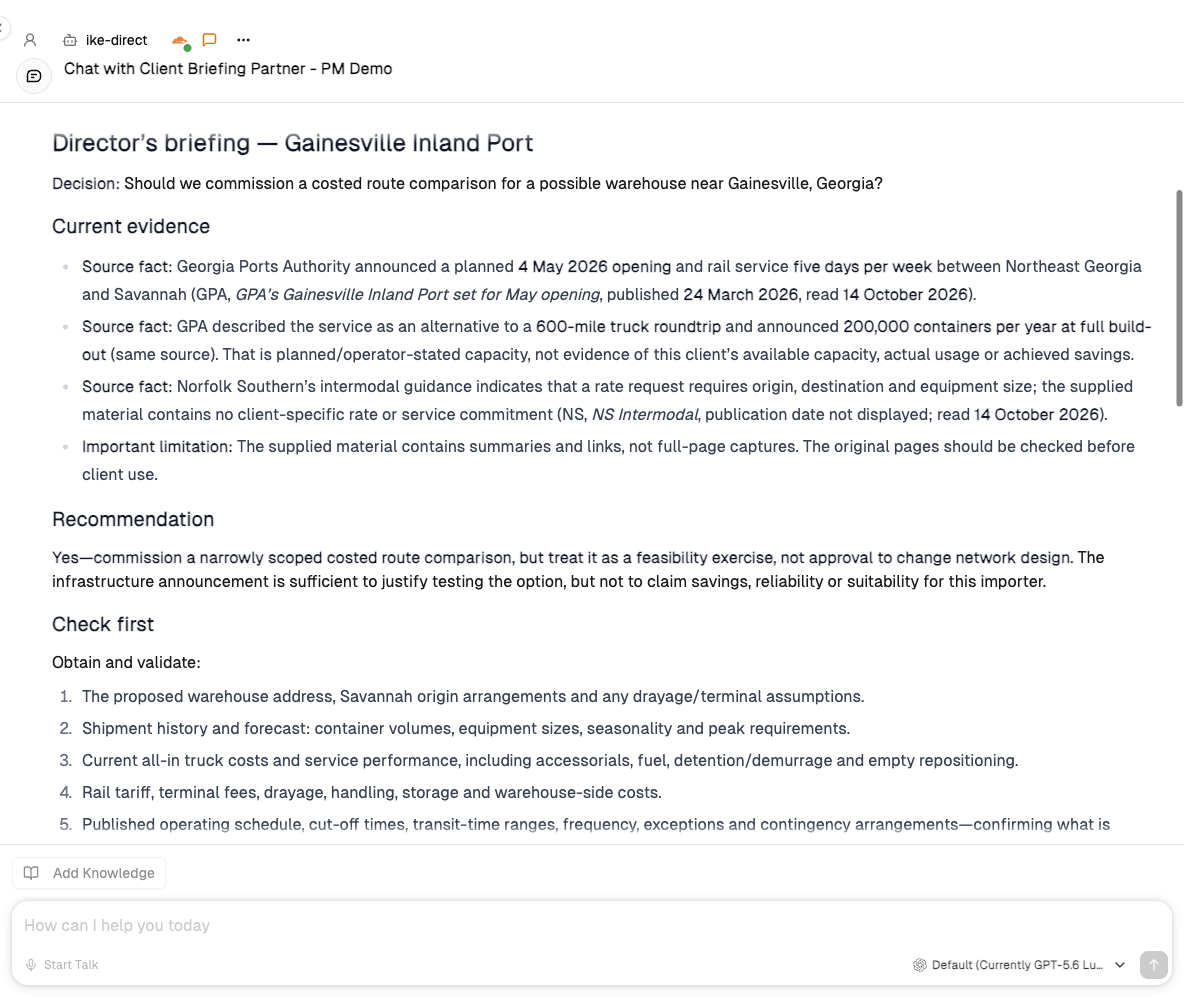
Read the first briefing and its update. Check what the new announcement changes, then try the same material in the Workbench.
View the recorded full-size screenshot.
A fictional regional importer is considering a warehouse near Gainesville, Georgia. The director wants to know whether an inland-port announcement justifies commissioning a costed route comparison.
IKE recommended that comparison. The announcement gave the client a reason to investigate; freight quotes, delivery commitments and warehouse terms were still missing. These are shortened versions of two recorded answers, using real announcements.
| First briefing | After the later announcement | |
|---|---|---|
| Evidence | Georgia Ports Authority, 24 March 2026: planned May opening and five-day rail service. | Norfolk Southern, 11 May 2026: the operator reports service running five days a week. |
| Next step | Commission a narrow feasibility comparison. | Ask for client-specific rates, available capacity, schedules and service commitments for the operating route. |
| Still unknown | Actual costs, shipment volumes, warehouse terms and delivery needs. | Those commercial questions still need answers. Announced network capacity leaves this client’s allocation open. |
The first answer suggested asking the logistics provider and carrier for a written, client-specific quote and service assumptions, then comparing truck-only with rail-plus-drayage on total cost, reliability and operational risk.
Read the complete first briefing · Read the follow-up answer · Check the later operator announcement
The recorded screenshot uses our saved Client Briefing Partner Persona. The starting exercise below uses Research Companion. Your answer will vary.
One mistake we caught: in a fresh conversation, IKE used the pack’s preparation date as the announcement date. We checked the originals and used their publication dates above. Check those dates in your own briefing, too.
Download the briefing pack. It contains the fictional client’s situation and short summaries linked to the Georgia Ports Authority and Norfolk Southern originals. Keep the later announcement summary for the follow-up.
Free includes selected models within your account allowance. An external provider connection is optional. See plans and limits.
Prepare the director’s briefing from this material. Should we commission a costed route comparison, and what needs checking first? Separate source facts, client assumptions and unanswered questions. Name each source and its publication date. Keep planned service separate from operating service and capacity separate from actual usage. Keep the briefing under 350 words.
Look for freight quotes, shipment volumes, warehouse terms and service commitments among the open questions. Inspect any proposed savings against the source. Check whether the answer distinguishes planned and operating service, then decide whether its next step is useful to the director.
Attach the later announcement summary in the same conversation and ask:
Does this change our next step? Show the earlier position, new evidence, what changes, and what remains unknown.
Check the original publication date as well as the conclusion. The operating picture can change while the client’s costs remain unanswered.
When you return, choose the Persona, inspect its selected sources, and bring the new evidence and the earlier result you checked. Then review what changes.
If this approach helps, create or edit a Persona for the director’s briefings. Set its responsibility and audience. Save the update rule above, including the requirement to name original source dates. Organize background captures and documents in Knowledge and deliberately link the relevant material to that Persona. Chat attachments and linked Knowledge are separate steps.
Develop a reusable Skill for the checking procedure after trying Research Companion. Specify the comparisons, source checks and questions a useful update must cover. Choose tools and permissions for the job; the director retains the decision about a commitment.
Keep an explicit copy of the briefing you checked. In the next fresh conversation, supply that copy and the new evidence. Our recorded exercise reused its associated source packs and saved update rule in a fresh conversation. That is the reuse this example demonstrates.
You can choose supported provider connections and models with your Persona. Confirm that connection’s eligibility and charges. Work and personal credentials have separate settings; confirm document access before adding client material.
If a colleague needs the method, explore creating and sharing Personas. If the task needs OpenClaw’s framework, review its managed hosting and terms. For a team that needs drafts routed for approval, scope the records, permitted actions and human decisions through a Design Partnership; terms are separate and the ADK remains in private preview.
Try the public briefing first. Open Research Companion in the Workbench, or compare two studies for another evidence problem.
Check supported model connection optionsYour Locus account works here. Open Research Companion with Direct, start a fresh conversation, and attach the briefing pack.