Research guide · Evidence
Two studies. One claim.
How far does the evidence go?
A council briefing says Housing First improves housing and health. Put the papers side by side before deciding what to write.
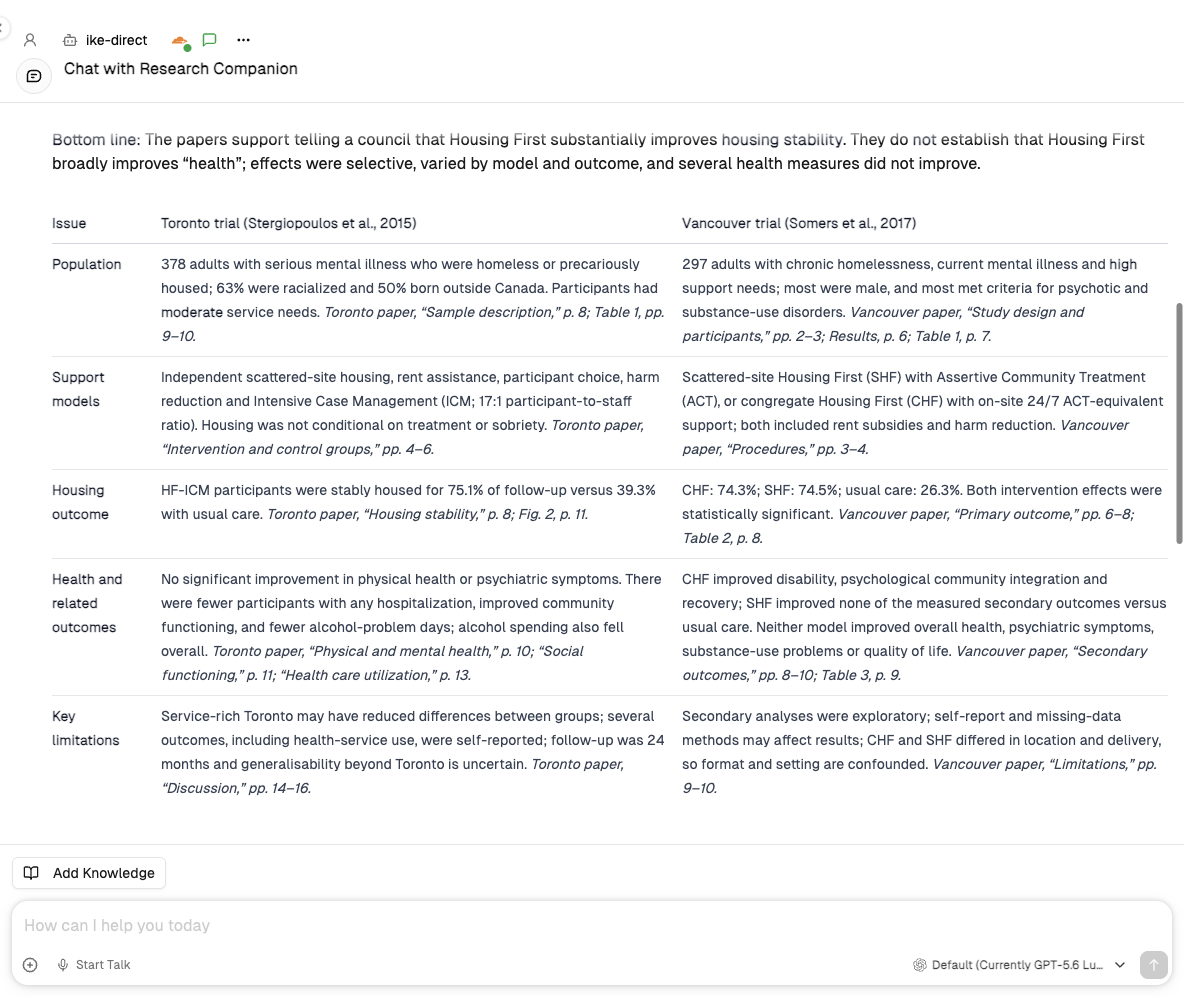
A council briefing says Housing First improves housing and health. Put the papers side by side before deciding what to write.
View the recorded full-size screenshot.
These two trials studied different populations and support models. IKE’s recorded comparison from the original PDFs gave us a clear statement about housing. The health findings needed more care. This shortened table links the results for checking.
| What to compare | Toronto, 2015 | Vancouver, 2017 |
|---|---|---|
| Who took part | 378 adults with moderate support needs. | 297 adults with high support needs. |
| Support | Scattered-site housing with Intensive Case Management. | Scattered-site or congregate housing with more intensive support. |
| Time stably housed | 75.1%, versus 39.3% with usual care. | 74.3% in congregate housing and 74.5% in scattered-site housing, versus 26.3% with usual care. |
| Where to check | Housing stability and Figure 2. | Primary outcome and Table 2. |
We wrote this summary from the comparison:
Both trials found substantially more time in stable housing than usual care. Health and related outcomes varied by measure and support model, so a broad claim that Housing First improves health needs closer qualification.
Check Toronto’s Physical and mental health section and Vancouver’s Table 3 before choosing a health claim. Similar housing percentages leave the differences in populations and support models intact. These older papers are a reading exercise; a current policy review needs more evidence.
The recorded screenshot shows IKE’s actual table. Its source locations are plain text to follow in the originals. This guide supplies the links for that check.
Open each article and choose Download PDF:
Open the Workbench with your Locus login. Select Research Companion, choose Direct, and start a fresh conversation. Attach both PDFs and paste this question. Keep the originals open.
Using these two papers, can we tell a council that Housing First improves both housing stability and health? Compare the populations, support models, measured outcomes and limits in a short table. Give a source section, figure, table or page for each important claim. Suggest two sentences we could responsibly use. Explain where a direct comparison would mislead. Use only these papers.
Open the Workbench. Free includes selected models within your account allowance; an external provider connection is optional. See plans and limits.
Check moderate and high support needs separately. Inspect housing results, then each health or service-use outcome. Follow the important claims to their source locations. Check that the table and proposed sentences preserve the limits of the comparison.
Ask in the same conversation:
A colleague says the Vancouver paper proves congregate housing is better for everyone. Which comparisons did the study actually test, and what further evidence would we need?
Inspect Tables 2 and 3 and the statistical-analysis section. In our recorded follow-up, IKE pointed out that each intervention was compared with usual care. A general ranking of the interventions requires further evidence. Check the tested comparisons before accepting that broader inference.
When you return, choose the Persona, inspect its selected sources, and bring the new evidence and the earlier result you checked. Then review what changes.
If this helps your work, create or edit a research Persona. Give it the audience and scope of the review. Organize papers and Locus captures in Knowledge, then link the sources relevant to this review. A PDF attached to a conversation and a document linked through Knowledge have separate roles.
Configure a reusable Skill around the procedure you found useful: extract each study’s population and intervention, compare the outcomes actually measured, locate the supporting passages, and draft a conclusion limited to those findings. The public exercise supplies that method in the question; you develop the specialist configuration afterward.
Keep the comparison you checked. For another paper, start a fresh conversation with your Persona, supply the new paper and earlier comparison, and ask which conclusions change. Inspect the selected sources and important passages again. This guide demonstrates the two-paper comparison and follow-up; another-paper continuation is the next exercise to test.
Choose supported provider connections and models as the task requires. Check the connection’s eligibility and charges. Separate work/personal credential settings leave source access as its own decision. Use public papers while you resolve access requirements for restricted material.
Choose tools and permissions around the researcher’s job. A reading exercise needs source inspection and human review. A team workflow that submits recommendations for approval needs agreed records, permitted actions and review steps through a Design Partnership, with separately agreed scope and terms; the ADK remains in private preview.
You can develop and share a useful Persona, or consider managed OpenClaw when its framework fits the research task. Review its trial, card and idle terms before choosing it. All next-step options remain available.
Try these papers in the Workbench, or follow one claim to its source.
Check supported model connection optionsYour Locus account works here. Open Research Companion with Direct, start a fresh conversation, and attach both PDFs.