Abstract
Agent-first application design requires builders and teams to think beyond screens, buttons, widgets, prompts, and context. The unit of system design becomes agent behavior: delegation, boundaries, entitlements, security, context, memory, and recovery.
For enterprise knowledge work, that shift means building apps around user, system, and agent behavior, with traceability, compliance, and evidence as first-class UX and DX requirements.
True agent-first applications allow for multimodal interactivity, delegation by the user to use tools and integrations, acting on the response from those tools using context and memory, agent-to-agent communication, and further multimodal interaction. This whitepaper considers those to be true agentic applications.
Yet agentic knowledge-work applications are still rare. Most products labeled agentic stop at conversation plus context bots, or chat plus RAG experiences that demo well but break under production requirements. The gap is not model capability. The gap is trust: shipping systems where outputs are in-scope, evidence-backed, controllable, and repeatable.
This paper proposes a platform thesis: reliable agent-first systems require first-class primitives for probabilistic behavior, constraints that stay attached end-to-end, and operational evidence. Those constraints include knowledge scope, permissions, approvals, lineage, artifacts, and regression over time. An Integrated Knowledge Environment (IKE) unifies capture, governed knowledge, and operations so agent behavior can be shipped and used with stable boundaries and replayable, reviewable execution.
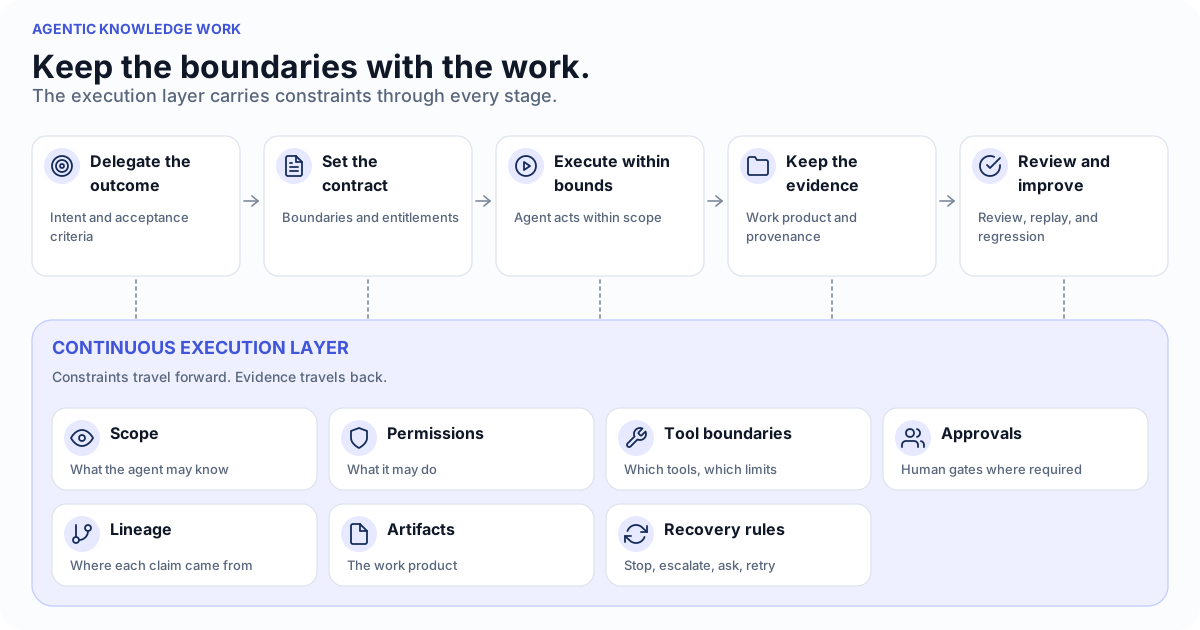
This is especially true for knowledge work UX and DX when using or creating agentic applications. IKE unifies capture, governed knowledge, and workflow operations so builders can create knowledge-work agentic applications, deploy them, and run them with stable behavior, boundaries, and reviewable execution.
Scope
This paper focuses on agentic applications for knowledge work. It is not about vibe-coding agents, consumer concierge agents, or pure chat/RAG context bots without tool delegation, bounded autonomy, and evidence-backed artifacts.
2026 launch addendum
The online launch addendum covers IKE Workbench, Direct Agents, Hosted OpenClaw, and Agent Applications, with links to current account offers and application guidance. The original thesis and paper retain their historical scope and terminology.
For today’s build method, see Build with IKE. Begin with SME knowledge, an idea, a prototype, an existing product, or data. Establish ontology and nomenclature early, agree human-owned intents, then compose and prove a useful knowledge application. The AML walkthrough connects that method to an example inside an established product.